Saturday, 27 May 2023

Peter Saxon - Flight Into Fear - Sexton Blake Library -Series 4, Number 360 - Jun 1956


Peter Saxon* - Flight Into Fear - Sexton Blake Library - Series 4, Number 360 - Jun 1956  

*`Peter Saxon` was a house pseudonym used by a number of writers. Blakiana credits the writing of this story to W Howard Baker.

This SBL story is definitely towards the pulpy end of the Blake spectrum.

The plot dovetails two stories, one being the story of a young woman plunged unwillingly into a world of mystery by the machinations of her feckless brother, the other concerning a case being investigated by Sexton Blake, involving a group of British-based US airmen involved in drug smuggling.

In the earlier stages, the taut prose helps keep the readers` attention, and the story of the young woman and her crooked brother is pretty strong. 

I have to say that as it progressed my interest did tend to wane. This is partly because the latter part of the story is very much concerned with the action/adventure aspect, rather less with the crime/detection. There is very little or no doubt as to who the main culprit is going to be.

Another failing here is that the Blake of this story is not really distinctively Blake-ish and towards the end the character bringing matters to a close could have been any one of a number of action heroes. 

I don`t want to give the impression that this was a terrible story - it wasn`t - but ultimately it`s just a moderately entertaining late`50s action/adventure/thriller type of thingy that you might read once with some enjoyment and probably never return to again. 


Thursday, 1 December 2022

James Stagg - Crime of Violence - Sexton Blake Library Series 4/403 Apr 1958


James Stagg - Crime of Violence - Sexton Blake Library - Series 4, Number 403 Apr 1958   

Published by the Amalgamated Press

Cover art by Carcupino (Fernando Carcupino ?)

Internal sketches by Margaret Higgins

Overall, a pretty good late `50s SBL, but not one of the best.

The story takes Blake to the Cotswolds, to the fictional village of Courton by the Water, which is pretty clearly a thinly disguised Boughton on the Water.

After an absurdly mannered description of Boughton/Courton and it`s model (i.e. miniature) village ("Even the model church clock keeps the time, and the  recorded chimes of the village church itself peal out in a sweet, diminutive cantata"), our man comes back to earth and begins to tell the story.

The story is not a bad one by any means, and is only marred by a few odd details. 

The first is the bizarre account of how the body of a little old lady is found hidden in a miniature Manor House in the model village. If I had a body to conceal, however small it might be, a model village would not be the first place I`d think of. I`ve checked, and the one at Boughton is 1/9 scale, but I would think it would still be a bit tricky. However, I`m prepared to take a relaxed view of this.

Throughout the story, Blake is portrayed as forming impressions of people based on the slightest encounters. 

In the case of one character, Marina Court, he starts off forming an aversion towards her for very little reason ("for himself, he rather disliked the girl on sight") and his attitude towards her does seem a little off-centre in places. A good example is his bizarre observation that after meeting her once for a few minutes at most, he has diagnosed her as suffering from a thyroid problem, and has gained various insights, which make no sense at all, as a result. Best to leave these things to a doctor, I would think. 

Having said that, the story is a solid and intriguing one which holds the attention. We get the return of Inspector Coutts from some of the earlier Blakes and a tale that brings together murder, mystery and much else. 

As is often the case with SBLS, it`s a good story, but with very little effort it could have been much better.


Tuesday, 9 August 2022

Peter Saxon - The Case of the Missing Bullion - Howard Baker -1969


Peter Saxon*  - The Case of the Missing Bullion  - Howard Baker  - 1969

Due to illness I wasn't able to review this while it was fresh in my mind. 

I recall it well enough to say it was a cracking little tale that sees Blake pitting his wits against a villain with aristocratic pretentions known as The Gent as a routine search for a missing young woman turns into something more sinister. 

The Gent is a great creation ;  urbane, courteous and ruthless to the point of psychopathy.

Blake is portrayed as polite and respectful to the people he meets, inclined to make more measured judgements than his assistant, Tinker. Unusually, he is portrayed as rather philosophical about the march of 1960s modernism even when one suspects it doesn't meet with his approval. 

Generally it is reasonably well-written but with attempts at period flavouring  (much talk of "swinging chicks" etc). Occasionally the writing inadvertently invites mockery ("she didn't like the way he glanced at her knees" and "she had never liked swarthy men with very thin moustaches"), but  this is rare.

I  am not a huge fan of 5th series Blake but I can't imagine many  fans of the great man being disappointed with this. 

* On the cover the book is credited to Peter Saxon, a house pseudonym. However, Peter Gordon is credited as author on the half-title page, title page and reverse of the title page. Blakiana  credits it to W Howard Baker. I'm no expert, but my money is on the mysterious Peter Gordon.


Friday, 22 July 2022

W A Ballinger - The Strange Face of Murder - Mayflower Dell - 1965 - Paperback


W A Ballinger*  - The Strange Face of Murder  - Mayflower Dell  - 1965

Paperback book, stated to be Sexton Blake Library,  5th Series, Number 20

*I gather W A Ballinger was a `house pseudonym` used by a number of different writers. I`ve checked on Blakiana but apparently the true author is unknown. Although I`ve read SBLs by a number of writers, I would hesitate even to make an educated guess.  


Ignore the atrocious artwork, this is actually an entertaining read. 

A comedy thriller, one could imagine this being adapted to be made into an Ealing film. As it is, unfortunately it's likely to languish in obscurity, saved from total neglect only by the Blake connection.

Which brings us to a question. Does it really deserve to be regarded as part of the Blake saga  ? In my view, yes,  but only by the skin of it's teeth. 

Blake appears repeatedly throughout the story, sometimes taking an active part in proceedings, but mostly it is concerned with Graham Sykes and his sidekick Johnny Hammond, two down-at-heel artists who make an ill-advised decision to set themselves up as private investigators and soon find themselves completely out of their depth. 

One has to wonder if it is actually some writer's unpublished novel that has simply been adapted into an SBL title, either to make a quick buck or simply to avoid it remaining unpublished. 

It is inevitably dated, with Sykes himself being portrayed as a 'lovable rogue' and Hammond as his 'hapless sidekick', and generally it is difficult to imagine it finding much of a readership today, not least because, as far as I know  it is only available as a  cheaply produced 1960s paperback. 

The ending does seem a little rushed, with some of the eventual explanations really not making much sense

Overall,  I enjoyed it but there again I am easily amused.

If you can pick up a cheap copy in reasonable condition  it  would  be  a good purchase, with the proviso that it's not likely to endear itself to Sexton Blake purists. 

Sunday, 8 May 2022

Pierre Quiroule (W W Sayer) - The Vanished Millions - Sexton Blake Library 330/1924 and 467 Feb 1935


Pierre Quiroule (W W Sayer)- The Vanished Million - Sexton Blake Library 330/1924 (reprinted as SBL 467/Feb 1935)

Author`s pseudonym sometimes misprinted as Pierre Quirole


This is not one I have in my own collection, I read it online on the Comicbookplus site. 

It is some time since I read it, but I remember it tolerably well hopefully.

This story features not only Sexton Blake and Tinker but also Mr Sayer`s own characters Granite Grant and Mademoiselle Julie. The action is set in both England and Latvia. 

The plot is sufficiently involved to hold the readers` interest, but not so involved as to become convoluted. 

The portrayal of Blake is very much as it should be - both a man of action and a thinking man, a determined purser of wrongdoers but also a man capable of compassion. 

As a general thing, my particular interest is in the Blake of the post-war years but it doesn`t pay to be dogmatic about these things and I would say this was an enjoyable read for me and one I would like to revisit at some point. 


Wednesday, 13 April 2022

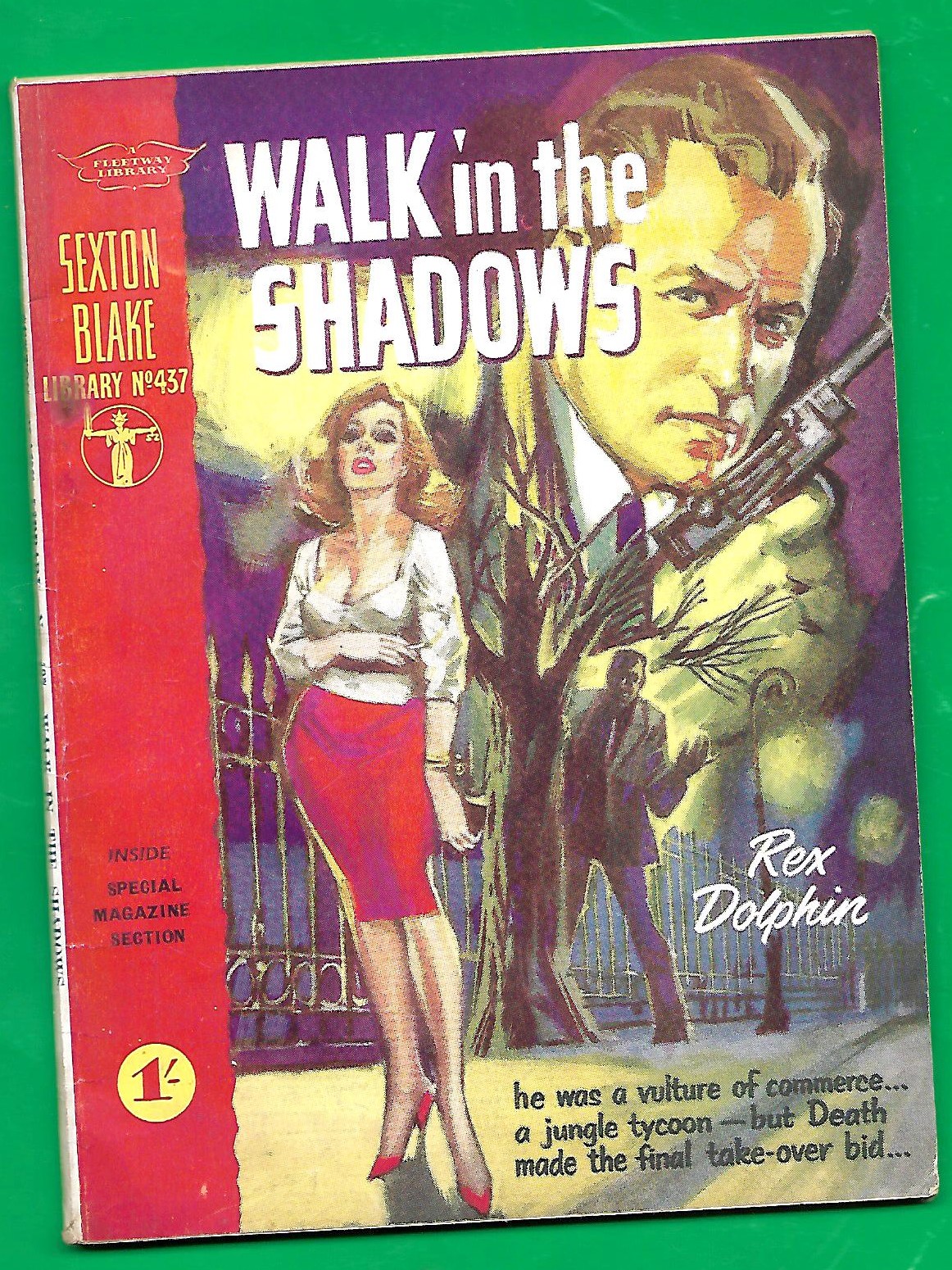
Rex Dolphin -Walk in the Shadows - Sexton Blake Library 437/Oct 1959


Rex Dolphin - Walk in the Shadows - Sexton Blake Library 437/Oct 1959

Cover art by Fratini (Renato Fratini)

An enjoyable and absorbing tale from Rex Dolphin (actually Reginald Charles Dolphin).

The strangely-named Mr Dolphin was not prone to enlivening his prose with unexpected literary flourishes, evocative descriptive passages or an array of quirky characters.

His strength is in his "keep the reader guessing" approach to his craft. 

Walk in the Shadows sees Sexton Blake investigating a murder in a workplace. As his enquiries continue, almost everyone he encounters has something to hide, a motive to have committed the murder or both.

A second murder, that takes place while his investigation is ongoing, does little to provide clarity. 

I very much doubt that many readers will arrive at the solution to the case ahead of Blake. 

Recommended reading, which made me want to seek out more of Rex`s writings. 


Wednesday, 23 March 2022

Arthur Kirby - High Summer Homicide - Sexton Blake Library/Fleetway - 503/1962 - Hank Janson


Arthur Kirby - High Summer Homicide - Sexton Blake Library 503/1962 - Fleetway

Credited to "Arthur Kirby as told to Richard Williams". In fact, it was written by Stephen Frances (aka Hank Janson) with revisions by W Howard Baker and George Paul Mann.

Artwork credited to `Camps` (full name Angel Badia Camps)

High Summer Homicide reads like two stories welded together. I can`t help thinking that too many authors were involved in this, seemingly with no-one taking an overall view.

The first section begins in a mildly Chandleresque vein, slightly laughable as the story is set somewhere near Worthing. 

Quite quickly this gives way to plain bad writing ("her long, silver-blonde hair jogged provocatively in a pony tail with every step that she took") as the fictitious storyteller, Blake`s journalist friend Arthur `Splash` Kirby leers lasciviously and longingly over an assortment of females. He seems surprised to find that women have legs, and this gives him great pleasure, though in my experience, it`s not that unusual  for them to possess these appendages. 

Unfortunately all this excitement doesn`t progress the story, which concerns a friend of Kirby`s who is missing, presumed murdered. 

I was about to give up, but on page 26 Blake takes charge of the case and the style of writing changes, so much so that one character has a complete personality transplant.

The story that emerges from this point on is really not too bad - maybe not great, but good enough.  There is a very well-written account of an undersea search for a body which gives a glimpse of the story this could have been. 

Really, it would have taken very little time effort to have made a better job of this. It`s not the worst story I`ve ever read, it`s certainly not the best. It could very easily have been better. 


Monday, 23 March 2015

A Sextonian Apology (and a Promise of Good Things to Come)


A thousand apologies for the lack of anything new on this blog in recent times.

I will be back with more Sextonianism (including further instalments of my Mark Hodder interview)
as soon as I possibly can.

Keep the Faith !

Nick

Sunday, 7 December 2014

Vintage Villainy ; Angela Rigley and Keith Chapman


Before we return to our look at the life and work of Mark Hodder, I`d like to think laterally  and bring to your attention two writers who`ve produced mysteries set in the nineteenth century.

The first is Angela Rigley. Ms Rigley resides in Langley Mill on the Notts/Derbys border - not too far from Chateau Hoonaloon as it happens - and has a number of novels to her credit. She is best known for her historical fiction but has also produced novels aimed at young adults and has recently diversified into editing manuscripts for her publisher.

An interview with Angela can be found at http://bluewoodpublishing.com/Authors/Interviews/I-AngelaRigley.html

Whilst remaining in the world of historical fiction, Lea Croft is the first novel of hers to feature a murder and mystery motif. "An everyday tale of muder and life in a Victorian village" say her publishers and indeed the author does bring a healthy dollop of murder and intrigue into the fictional Derbyshire village that gives the book its` title.


Keith Chapman is an old friend of this blog. His writing career has included stints with the Sexton Blake Library and the Edgar Wallace Mystery Magazine. After working for many years as an editor and journalist in recent times he has written a number of novels, mainly Black Horse Westerns (under the name Chap O` Keefe), though with occasional deviations into other genres, notably Witchery ; A Duo of Weird Tales.

A two-part interview with Keith telling the fascinating story of his writing career was posted at http://tommcnulty.blogspot.com on 8 and 14 Nov 2014.

In a recent e-mail , Keith commented on his fictitious Pinkertons` Detective Joshua Dillard, central character of The Lawman and the Songbird and others ;

"You could say that after all these years I`m still trying to fly the flag for hardboiled mystery, albeit my detective Joshua Dillard, unlike Sexton Blake, operates only in the 19th century !"


Saturday, 15 November 2014

The Mark Hodder Interview Part Four


For some time now I`ve been posting my recent interview with Sexton Blake author Mark Hodder on this blog in instalments.
 
Parts 1 - 3 apppeared on 8, 15 and 19 October respectively so now it must be time for Part Four !
 
**************************
 
Q)  From comments you`ve posted online* I would think you have a very different worldview to that of Blake, yet you clearly have an enduring fascination with his world. Why do you think that is ?
 
A) Yep. There you have Blake upholding the superiority of the British Empire and British principles and British character...and here you have me putting the boot in at every opportunity.
 
Here`s the truth. When you look at propaganda it tells you more about what it`s seeking to defeat than what it`s striving to support. It`s that old truism of psychology : listen to how people insult others, for it reveals what they`re most deeply afraid of. 
 
Blakes` world is intriguing to me because, in the early years, it is so crammed with self-confidence : this is right, that is wrong, end of story. That unquestioning attitude then gets a kick in the teeth with the First World War , and we have this sudden explosion of super-criminals most of whom can be read as physically or psychologically damaged, or as people who can no longer understand how they fit into society.
 
The Second World War knocks the Blake world even harder. Now the adventures are suddenly about ordinary people effected by crime, as if all the big world-spanning ideas and conflicts have been relocated to the average persons` kitchen. Aristocracy becomes an irrelevance. And on into the `50s and `60s , during which time Blake hardly represents anything but himself, in a manner that often feels rather empty and soulless.
 
So for me, the Blake saga, from beginning to end, is a historical document, but rather than examining history from on high, as historians tend to do,  it observes it from pavement level  and so gives a far better feel for how the world was.
 
************************** 
 
That concludes Part Four of my interview with Mark Hodder, author of The Silent Thunder Caper and one of the contributors to the short story collection Zenith Lives. Both titles can be acquired from publisher Obverse Books at http://obversebooks.co.uk .
 
Part Five will be along soon, so watch this space !
 
 
* "The capitalist system, in divorcing itself from social responsibility, has so undermined itself that people are now waking up and fighting back." Mark Hodder - `More Thoughts on Steampunk` -  Mark Hodder Presents, 27 Feb 2012 ( http://markhodder.blogspot.co.uk ).


W Howard Baker - Walk in Fear - Sexton Blake Library 4/396 1957


W Howard Baker - Walk in Fear - Sexton Blake Library - Series 4, Number 396 - 1957

A very classy performance from SBL editor W Howard Baker here, not necessarily the kind of thing I associate with him.

Walk in Fear is partly a  mildly humorous detective story, partly a satire on the publishing industry. More than once I wondered if some characters were drawn from life, especially the more scathing portrayals.

The writing is often witty, with some very keen insights here and there, as in this portrayal of one characters` wartime RAF service ;

"They had been boys in 1940, contemptuous of death because they did not truly understand it ; unafraid because they were unable to appreciate that they were not immortal. They had taken risks because they hadn`t really divined the risks they were taking. They had lived dangerously, and the business of living had been a grand and glorious game.

But 1940 was seventeen years behind them now. They were all mature, reasonable, thinking men. Only John Bovis remained.

He was not mature. Often he was not even reasonable. Rarely did he consciously think."

There are one or two in-jokes here and there ; at one point Blake comments "I had some dealings with Edgar Wallace long ago." Shortly afterwards, one character expresses what may be Bakers` own experience of editing the SBL ; "Most of the trouble in my life, it seems to me, has been caused by one damned writer or another."

The plot is quite ambitious in its` scope, and the writer seems reluctant to stay within the confines of one genre - is it satire ? comedy thriller ? traditional whodunnit ? . I thought I detected the hand of Jack Trevor Story here and there, an impression re-inforced when a character from his The Season of the Skylark makes an unexpected appearance. Having said that, better men than me accept WHBs` claim to sole authorship, and I am far from being an expert on either mans` work.

Perverse though it may sound, I would not like every Blake story to be like this, but it is a personal favourite.


Footnote - after Amalgamated pulled the plugs on the SBL, WHB carried on with the series for a time. During this period an expanded version of Walk in Fear appeared with the title Every Man an Enemy (SBL Series 5, Number 22, 1966).

Every Man an Enemy was published repeatedly - by Mayflower in 1966, by Zenith Publishing (London, date unknown) and in the US by MacFadden-Bartell. It was also included in The Fifth Sexton Blake Omnibus (Howard Baker Books, 1969).


Voices from America - Daniel Stashower and Lora Roberts


I abandoned the practise of occasionally looking at the wider world of crime fiction some time ago, largely because I didn`t feel I had the time to do it justice.
 
Having said that, visitors to this blog may be interested in two books I read not so long ago, The Dime Museum Murders by Daniel Stashower and The Affair of the Incognito Tenant by Lora Roberts.
 
I don`t review anything unless it`s fairly fresh in my mind but I will just say that I personally found The Incognito Tenant the more satisfying read and I will certainly be finding out whether Ms Roberts, who has a number of crime novels to her name, has written any other tales featuring her character Charlotte Dodson.


I rarely visit the websites of writers ( or actors ) as it only encourages them, but I`m sure if you have a quick search on the web you`ll find plenty of material about Roberts and Stashower, both of whom have added their own personal twist to some fairly familiar ingredients with imnpressive effect.


Sunday, 19 October 2014

The Mark Hodder Interview Part Three ; Plummer v Zenith


We come now to the third part of my recent interview with Mark `The Silent Thunder Caper` Hodder.

Parts One and Two were posted on this blog on 8 and 15 October of this year and are still to be found lurking there.

We turn now to my third and most predicable question ;

Q) Who are your favourite characters from the Blake tales and why ?

A) I`ve always had a soft spot for George Marsden Plummer , simply because his early tales, by the mysterious Michael Storm*, are exceedingly well-written, and also because I think it`s a great idea : a high-ranking Police detective who uses his knowledge of the criminal underworld to his own advantage. That was ahead of its` time for sure. I like the psychology of Plummer. He believes he deserves better by virtue of his family connections to aristocracy , and thinks his less lordly status is an unfortunate quirk of fate that flies in the face of what`s `right`. I really connect with that , as my mother had the same attitude, though she never became a super-villain.

Zenith, of course, is right there at the top of the league. Anyone who`s read Zenith loves Zenith. He has an otherworldliness that really appeals. In some respects he`s an interesting counterpoint to Plummer in that he has the aristocratic position but considers it worthless.

This question of the value of the aristocracy  and the difference (if any) between an aristocrat and a commoner was integral to the zeitgeist of the inter-war years and has always fascinated me. It`s even become a theme of my own `Burton and Swinburne` series. Perhaps it`s why I chose to revive The Three Musketeers**. Three common criminals hiding behind a facade of `Hooray Henrys` ..that`s got to be fun ! A trio of psychopathic Bertie Woosters !

That concludes part three of my Mark Hodder interview, watch this space for more from me and him !

In the meantime you can keep up to date with this literary lad by visiting these sites ;
http://obversebooks.co.uk and www.mark-hodder.com .


* For more on Michael Storm ; http://bearalley.blogspot.co.uk/2007/07/michael-storm.html

** Not the Dumas characters, but three villains from Sextons` illustrious past ;
  http://www.mark-hodder.com/Blakiana/musketeers  .

Desmond Reid - High Heels and Homicide - Sexton Blake Library 4/405 1958


DESMOND REID - HIGH HEELS AND HOMICIDE - SEXTON BLAKE LIBRARY 4/405 1958

Two beauty contestants are kidnapped and Blake is asked to investigate. Along the way he uncovers an espionage ring and encounters again a face from the past.

This story, actually written by John Purley and revised by George Paul Mann (aka Arthur MacLean), is another example of the `Reid` name being attached to work by (one presumes) an unknown writer. It is interesting in that it marks the return of one of the pre-war Blake villains, Huxton Rymer.

Criminally-inclined former surgeon Huxton Rymer, the creation of writer G H Teed, appeared in various Blake stories 1913 - 36, with a short break while Teed served in the army during World War One. Some question whether the last of the Rymer stories was Teeds` work but as he died in 1938 we can`t very well ask him.

I have done a bit of checking and find that an earlier SBL, the Mansion on the Moor (3/43), was credited to John Purley and during that year Collectors Digest magazine described him as a 43-year old Worcester-based freelance journalist contributing on a one-off basis.  

The return of Rymer enables Blake to expand on the mans` character and attitudes ;

"If you`d blundered in on him he would have killed you. You know that as well as I do ! He`d have done it regretfully, but he`d have done it just the same. I think he`s fond of us - both of us - in his own odd way, but if it was your life or his liberty, it would be your life !"

On that cheerful note the investigation begins in earnest.

Does it work ? Not 100%. There is considerable humour to be extracted from the opening chapters, in which a bevy of petulant starlets and their over-ambitious parents and managers descend on a long-suffering hotel manager, but that joke is soon run into the ground.

There are one or two changes of pace and mood, all of which seem to breeze in out of nowhere. Various fruitful directions are indicated, particularly as Blake and Tinker begin to show signs of strain, and even to despair of saving the kdnapped girls, but none is really explored. The story lasts well under the usual 64 pages but still seems over-long.

It`s not too bad, but one wonders why George Paul Mann couldn`t have ironed out a few faults.

It`s certainly not the worst story I`ve read, but equally, it`s not the best either.

Wednesday, 15 October 2014

The Mark Hodder Interview Part Two : The Blakiana Guy


As you may know, Sexton Blake was recently reborn, his first new adventure being Mark Hodders` The Silent Thunder Caper, available from Obverse books via their website.

Mark was kind enough to let me interview him for this blog recently, and I am posting the details here in instalments.

In the first part of the interview (this blog, 8 Oct 2014), Mark told us that his intial encounter with Sexton Blake was far from encouraging. Still, this plucky young chap persevered. His investigations were both ardent and intrepid and soon he became The Blakiana Guy.

But let him tell his own tale...

Q)  Clearly you were not discouraged for long and eventually set about amassing a fairly impressive Blake collection and running the much-missed (by me, anyway) Blakiana website. Tell us about that.

A) The first thing you need to know is that the Blakiana site is alive and well, here ; www.mark-hodder.com/Blakiana .

The site came about through a mix of boredom and fascination. The boredom was caused by me working at an office job in which I completed my assigned daily tasks so quickly and satisfactorily that I was finished by lunchtime. I knew that if I admitted this to my manager I`d end up with a bigger workload but the same pay, so I kept my mouth shut...better to hand in my work at the end of the day and pretend my time had been filled by it !

Next problem ; what to do with the spare hours ? By this point I was hooked on Blake , so it felt natural to build a website about him. Blakiana was thus created in office hours behind my boss`s back. I can confess to that now since i can`t be fired in retrospect !

The site was fine - and ever-expanding - for about five years but then got infected by malware and had to be taken offline.

This happened at the same moment I got my first publishing deal, and I was so consumed by writing novels that I had no time to restore it. However, earlier this year I took time out to rebuild it and move it to a new server. So Blakiana is back and I`m very happy about it.

That`s the end of this exciting episode. The next instalment will be along as soon as it can be done, so remember, Watch this Space for more musings from the Blakianas Guy as he takes up the tale of how he went from fansite geezer to bona fide Blake author.


Richard Williams - Somebody Wants Me Dead - Sexton Blake Libray 4/500 1960


Richard Williams - Somebody Wants Me Dead - Sexton Blake Library - 4/500 - 1960

Credited to `Richard Williams`, this story was in fact the work of Stephen Frances, better known as Hank Janson.

In the first part of the book, the central character is the marvellously-named Harry Snogg, a professional detective story writer, author of the hard-boiled Ryley Steele series of crime novels.

He is also as impressionable as wet putty, so when he stumbles upon an ongoing bank robbery by chance, it isn`t long before he becomes Ryley Steele - in his own mind, if not to anyone else !

Soon Sexton Blake is involved, and growing more than a little weary of hapless Harrys` attempts at sleuthing.

If the first part of the story is concerned largely with Harry/Ryley, the second is more concerned with Blake. While the first part has its` flashes of humour and the odd writerly flourish ("The first hint of approaching night blunted the brightness of the day."), the second is more terse, the action more hard-hitting.

Its` interesting how Mr Williams/Jansen seems to have adapted himself well to writing SBLs. Had I read this blindfold (so to speak), I would have assumed it was the work of W Howard Baker. Jansen was the author of another `Richard Williams` Blake tale,  The Iron Box, and that also fits seamlessly into the genre.

I`ve read this several times, which is why my copy is falling apart, and always enjoyed it. If you`re looking for a blend of humour, crime and detection, this is very likely the one for you.


Wednesday, 8 October 2014

The Mark Hodder Interview. Part One - An Initial Encounter ; "THIS was Sexton Blake !"


As I`ve mentioned before, celebrated Saville-Row-suited sleuth Sexton Blake has been reborn, re-invigorated and and renewed by the undoubted skills of Mark Hodder and the determination of  Stuart Douglas.

It is with great pleasure that I bring you this interview with the redoubtable Mr H, whose penmanship is equalled only by his courtesy and his commitment to the cause of Sextonianism.

The interview will be delivered to you in instalments, hopefully at very regular intervals but interspersed with other items relating to the excellent Mr Blake.

It may enhance your reading pleasure if you try to imagine this meeting of minds taking place in some appropriate fictitious setting. I personally would want to imagine the encounter occurring in a dimly-lit basement bar somewhere near Londons` dockland in the immediate post-war period.

Q) I believe your initial encounter with a Sexton Blake adventure was not exactly encouraging ?

A)  It was the Sexton Blake Library fifth series novel `The Witches of Notting Hill` by W A Ballinger (actually W Howard Baker).

I`d come to Blake by way of the modern-day Robin Hoods (or `Durable Desperados`) ; characters like The Saint, Bulldog Drummond, Tiger Standish, Nighthawk, Blackshirt, The Toff and so forth. Among them I`d encountered Norman Conquest and Zenith the Albino, both of whose origins lie in Blake tales.
 
My initial research into Blake wasn`t promising. "A cheap Sherlock Holmes rip-off" about sums it up (a judgement I now know to be totally erroneous). As a huge Holmes fan I wasn`t much enthused.

It kept nagging at me, though ; "I ought to read some Sexton Blake". So when I saw `Witches...` in a secondhand bookshop I snapped it up and... God it was awful ! I couldn`t understand how such drivel could have such an incredibly long history.

After recovering from that wasted reading time I thought I should give it another chance and perhaps look out for some of the earlier material. Not long after, a complete set of 1919 Union Jack magazines came up on E-Bay. It co-incided with me having a bit of cash to spare so I bid and won. The moment I eased open one of those browned and crumbly pages with its` tiny print and advertisements promising manly moustaches  and cures for blushing , I was hooked. THIS was Sexton Blake ! 

The next instalment follows shortly. In the meantime you can learn more of the activities of Hodder and Douglas by clicking on these links ;


http://obversebooks.co.uk  

www.mark-hodder.com


Tuesday, 29 July 2014

The Return of Sexton Blake


As you may know, the Sexton Blake Library ceased trading in 1963.

 It`s a myth that Sexton stopped having new adventures at that point as there were a couple of new titles ( Simon Ravens` much-maligned Sexton Blake and the Demon God appeared as a book and TV series in 1978.  I personally enjoyed it though it didn`t please the purists ! ) but these were exceptions rather than the rule.

While  most fans contented themselves as best they could by collecting vintage examples of Sextonian sleuthing, two men plotted together in their secret lair. One was Mark Hodder, erstwhile proprietor of the greatly missed (by me, anyway) Blakiana website, the other was a shadowy figure known only as Stuart Douglas.

They experienced setback, they experienced delays, but they were strangers to discouragement, distractions and diversions. At last, the long wait was over. Now was the time to unleash their vision on the world.

Was the world ready ?  Only time would tell. The time was right for Sexton Blake to return !

Catch up with the latest adventure of our Saville-Row-suited sleuth between the covers of Mark Hodders` The Silent Thunder Caper, published by Stuart Douglas` Obverse Books ( http://obversebooks.co.uk ) . In addition to Mr Hodders` tale , the volume also contains a slice of vintage Sextonianism,  G H Teeds`  The Wireless Telephone Clue, which originally appeared in 1922. 

Happy Reading !


Thursday, 29 May 2014

Walter Tyrer - A Writers` Life


Regular visitors to this blog can hardly be unaware of my fondness (some would say fascination) with the works of Walter Tyrer. Whether it`s The Strange Affair of the Shotgun Sniper, The Crime at Fenton Towers or one of his many other SBL titles, Walt`s the man for me.

Until recently, I have known little about the life of our witty wordsmith but now I am in a position to do something I`ve long wanted to do, which is to provide the world with a potted biog of Mr Tyrer.

I`ve previously referred to Walter as having grown up "in a tough part of Liverpool" and engaging in a highly lucrative writing career which eventually saw him  set up home in swish Kingston Upon Thames.

I`ve since been fortunate to hear from one of his daughters, retired journalist Jennifer de Fries, who was able to correct the impression I had formed ;

"It wasn`t quite the rags-to-riches story the blog mentions but the family did struggle when his mother was widowed. He must have won a scholarship (I never thought to ask) and became a 16 year old Midshipman in the Royal Navy in World War One."


War service over, Walter turned his hand to writing, initially penning some of the schoolboy stories which were popular at the time. I believe he had his first book published in 1921.

 He was later to reflect with wry amusement on the stories he wrote at that time, stories which reflected a world he had, presumably, never encountered in real life ;

"For years I wrote about mysterious public schools with neither discipline nor lavatories, where everything happened in the same queer place called the Quad and my characters never emerged from an odd form called the Shell."

Having cut his teeth on schoolboy stories it was soon time for some stylistic diversification. He pursued a lucrative career as a freelance writer of short stories, embracing a number of different genres as he did so. While it`s true that he penned a number of novels, it seems that his work for short story magazines financed his upward mobility. He contributed cowboy stories to the Western Library series and romances to the Miracle Library.  He also wrote for the Lucky Star Library under the name Raven Head*.

Now came World War Two. I am indebted once again to Jennifer de Fries  for her recollections ;

"When we moved (to Kingston Upon Thames) I was aged seven, my sister eleven ,and we spent nights of the Blitz in the large wine cellar in the garden, complete with electricity and tiny cooker. My father did ARP (acted as an Air Raid Precaution warden) and fire-watching but worked in Fleet Street most days, not forgetting the Press Club."


In the post-war period writers like Walter Tyrer and John Hunter may have begun to seem a little old-fashioned. The Sexton Blake Library was also undergoing something of a crisis. The world had seen  Hitler and Stalin and had no more appetite for super-villains. SBL mysteries became lower-key, often with regional settings and crimes that were less exotic than in the past.

Many freelance writers of the pre-war period found a new home writing for the SBL, but few did so with the wit and ingenuity that characterised Walters` works at this time. It`s true, as Jennifer de Fries comments "he was never at a loss for a plot and I think he was very good at dialogue" but to my mind it`s more than that  - he had class.  


                                                      Walter Tyrer 1900 - 1978


Footnotes

*Other pseudonyms used by Walter are J T Lang and Oliver Seed. I am not aware of any others.

As ever, thanks to Keith `Chap O`Keefe` Chapman, Ray Elmitt and Jennifer de Fries.


Thursday, 15 May 2014

Philip Chambers

Once again this blog is indebted to Keith Chapman, this time for drawing my attention to a posting about Philip Chambers, who wrote a number of Sexton Blakes in the `60s, from Finnish blogger Juri Nummelin.

Keith has been able to add valuable information in a comment, which will no doubt be of interest to Sextonians.

To see the posting ;

http://pulpetti.blogspot.com/2014/05/philip-chambers-and-sexton-blake.html