Showing posts with label Book reviews. Show all posts

Saturday, 27 May 2023

Peter Saxon - Flight Into Fear - Sexton Blake Library -Series 4, Number 360 - Jun 1956


Peter Saxon* - Flight Into Fear - Sexton Blake Library - Series 4, Number 360 - Jun 1956  

*`Peter Saxon` was a house pseudonym used by a number of writers. Blakiana credits the writing of this story to W Howard Baker.

This SBL story is definitely towards the pulpy end of the Blake spectrum.

The plot dovetails two stories, one being the story of a young woman plunged unwillingly into a world of mystery by the machinations of her feckless brother, the other concerning a case being investigated by Sexton Blake, involving a group of British-based US airmen involved in drug smuggling.

In the earlier stages, the taut prose helps keep the readers` attention, and the story of the young woman and her crooked brother is pretty strong. 

I have to say that as it progressed my interest did tend to wane. This is partly because the latter part of the story is very much concerned with the action/adventure aspect, rather less with the crime/detection. There is very little or no doubt as to who the main culprit is going to be.

Another failing here is that the Blake of this story is not really distinctively Blake-ish and towards the end the character bringing matters to a close could have been any one of a number of action heroes. 

I don`t want to give the impression that this was a terrible story - it wasn`t - but ultimately it`s just a moderately entertaining late`50s action/adventure/thriller type of thingy that you might read once with some enjoyment and probably never return to again. 


Thursday, 1 December 2022

James Stagg - Crime of Violence - Sexton Blake Library Series 4/403 Apr 1958


James Stagg - Crime of Violence - Sexton Blake Library - Series 4, Number 403 Apr 1958   

Published by the Amalgamated Press

Cover art by Carcupino (Fernando Carcupino ?)

Internal sketches by Margaret Higgins

Overall, a pretty good late `50s SBL, but not one of the best.

The story takes Blake to the Cotswolds, to the fictional village of Courton by the Water, which is pretty clearly a thinly disguised Boughton on the Water.

After an absurdly mannered description of Boughton/Courton and it`s model (i.e. miniature) village ("Even the model church clock keeps the time, and the  recorded chimes of the village church itself peal out in a sweet, diminutive cantata"), our man comes back to earth and begins to tell the story.

The story is not a bad one by any means, and is only marred by a few odd details. 

The first is the bizarre account of how the body of a little old lady is found hidden in a miniature Manor House in the model village. If I had a body to conceal, however small it might be, a model village would not be the first place I`d think of. I`ve checked, and the one at Boughton is 1/9 scale, but I would think it would still be a bit tricky. However, I`m prepared to take a relaxed view of this.

Throughout the story, Blake is portrayed as forming impressions of people based on the slightest encounters. 

In the case of one character, Marina Court, he starts off forming an aversion towards her for very little reason ("for himself, he rather disliked the girl on sight") and his attitude towards her does seem a little off-centre in places. A good example is his bizarre observation that after meeting her once for a few minutes at most, he has diagnosed her as suffering from a thyroid problem, and has gained various insights, which make no sense at all, as a result. Best to leave these things to a doctor, I would think. 

Having said that, the story is a solid and intriguing one which holds the attention. We get the return of Inspector Coutts from some of the earlier Blakes and a tale that brings together murder, mystery and much else. 

As is often the case with SBLS, it`s a good story, but with very little effort it could have been much better.


Tuesday, 9 August 2022

Peter Saxon - The Case of the Missing Bullion - Howard Baker -1969


Peter Saxon*  - The Case of the Missing Bullion  - Howard Baker  - 1969

Due to illness I wasn't able to review this while it was fresh in my mind. 

I recall it well enough to say it was a cracking little tale that sees Blake pitting his wits against a villain with aristocratic pretentions known as The Gent as a routine search for a missing young woman turns into something more sinister. 

The Gent is a great creation ;  urbane, courteous and ruthless to the point of psychopathy.

Blake is portrayed as polite and respectful to the people he meets, inclined to make more measured judgements than his assistant, Tinker. Unusually, he is portrayed as rather philosophical about the march of 1960s modernism even when one suspects it doesn't meet with his approval. 

Generally it is reasonably well-written but with attempts at period flavouring  (much talk of "swinging chicks" etc). Occasionally the writing inadvertently invites mockery ("she didn't like the way he glanced at her knees" and "she had never liked swarthy men with very thin moustaches"), but  this is rare.

I  am not a huge fan of 5th series Blake but I can't imagine many  fans of the great man being disappointed with this. 

* On the cover the book is credited to Peter Saxon, a house pseudonym. However, Peter Gordon is credited as author on the half-title page, title page and reverse of the title page. Blakiana  credits it to W Howard Baker. I'm no expert, but my money is on the mysterious Peter Gordon.


Friday, 22 July 2022

W A Ballinger - The Strange Face of Murder - Mayflower Dell - 1965 - Paperback


W A Ballinger*  - The Strange Face of Murder  - Mayflower Dell  - 1965

Paperback book, stated to be Sexton Blake Library,  5th Series, Number 20

*I gather W A Ballinger was a `house pseudonym` used by a number of different writers. I`ve checked on Blakiana but apparently the true author is unknown. Although I`ve read SBLs by a number of writers, I would hesitate even to make an educated guess.  


Ignore the atrocious artwork, this is actually an entertaining read. 

A comedy thriller, one could imagine this being adapted to be made into an Ealing film. As it is, unfortunately it's likely to languish in obscurity, saved from total neglect only by the Blake connection.

Which brings us to a question. Does it really deserve to be regarded as part of the Blake saga  ? In my view, yes,  but only by the skin of it's teeth. 

Blake appears repeatedly throughout the story, sometimes taking an active part in proceedings, but mostly it is concerned with Graham Sykes and his sidekick Johnny Hammond, two down-at-heel artists who make an ill-advised decision to set themselves up as private investigators and soon find themselves completely out of their depth. 

One has to wonder if it is actually some writer's unpublished novel that has simply been adapted into an SBL title, either to make a quick buck or simply to avoid it remaining unpublished. 

It is inevitably dated, with Sykes himself being portrayed as a 'lovable rogue' and Hammond as his 'hapless sidekick', and generally it is difficult to imagine it finding much of a readership today, not least because, as far as I know  it is only available as a  cheaply produced 1960s paperback. 

The ending does seem a little rushed, with some of the eventual explanations really not making much sense

Overall,  I enjoyed it but there again I am easily amused.

If you can pick up a cheap copy in reasonable condition  it  would  be  a good purchase, with the proviso that it's not likely to endear itself to Sexton Blake purists. 

Sunday, 8 May 2022

Pierre Quiroule (W W Sayer) - The Vanished Millions - Sexton Blake Library 330/1924 and 467 Feb 1935


Pierre Quiroule (W W Sayer)- The Vanished Million - Sexton Blake Library 330/1924 (reprinted as SBL 467/Feb 1935)

Author`s pseudonym sometimes misprinted as Pierre Quirole


This is not one I have in my own collection, I read it online on the Comicbookplus site. 

It is some time since I read it, but I remember it tolerably well hopefully.

This story features not only Sexton Blake and Tinker but also Mr Sayer`s own characters Granite Grant and Mademoiselle Julie. The action is set in both England and Latvia. 

The plot is sufficiently involved to hold the readers` interest, but not so involved as to become convoluted. 

The portrayal of Blake is very much as it should be - both a man of action and a thinking man, a determined purser of wrongdoers but also a man capable of compassion. 

As a general thing, my particular interest is in the Blake of the post-war years but it doesn`t pay to be dogmatic about these things and I would say this was an enjoyable read for me and one I would like to revisit at some point. 


Wednesday, 13 April 2022

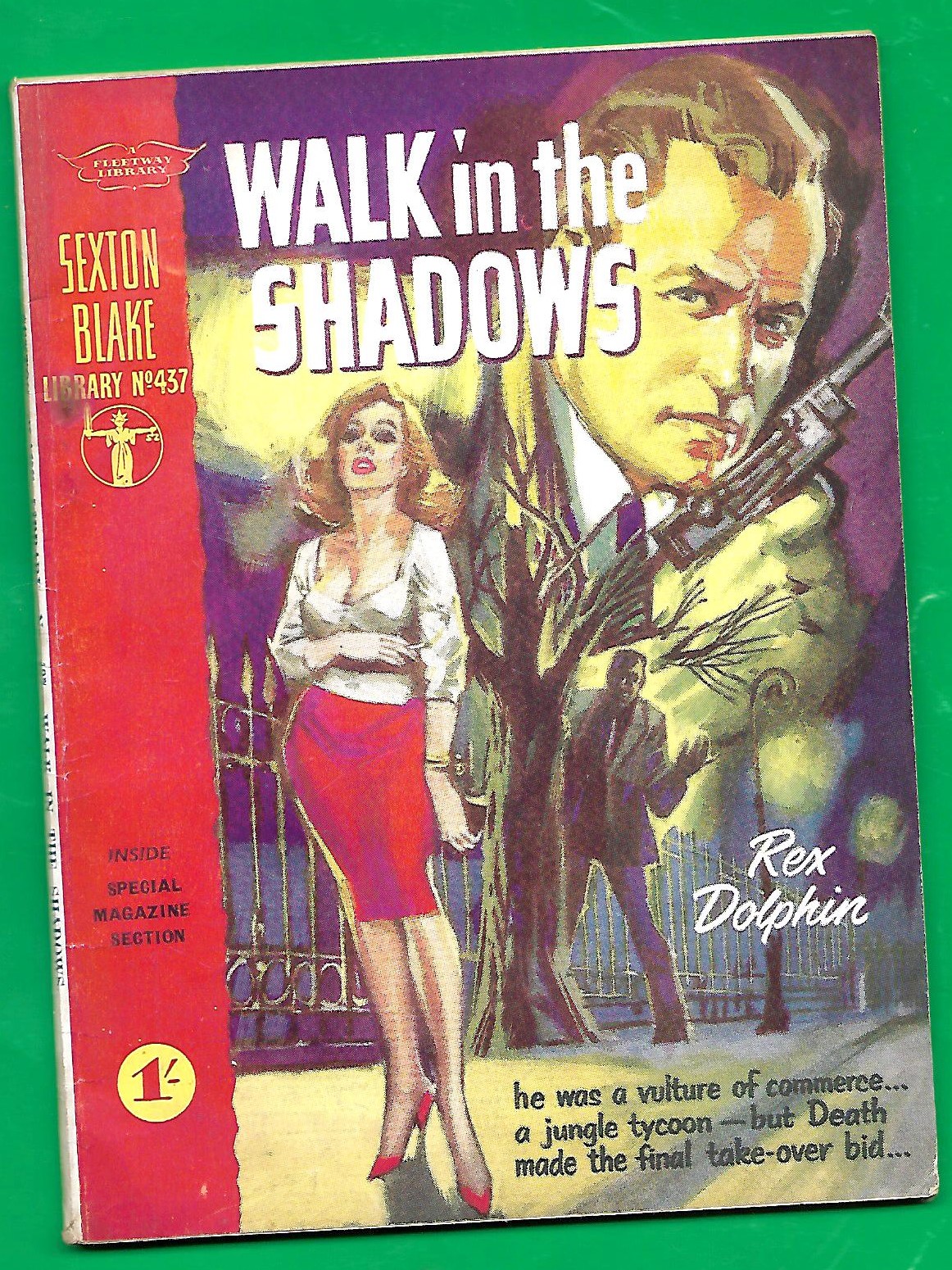
Rex Dolphin -Walk in the Shadows - Sexton Blake Library 437/Oct 1959


Rex Dolphin - Walk in the Shadows - Sexton Blake Library 437/Oct 1959

Cover art by Fratini (Renato Fratini)

An enjoyable and absorbing tale from Rex Dolphin (actually Reginald Charles Dolphin).

The strangely-named Mr Dolphin was not prone to enlivening his prose with unexpected literary flourishes, evocative descriptive passages or an array of quirky characters.

His strength is in his "keep the reader guessing" approach to his craft. 

Walk in the Shadows sees Sexton Blake investigating a murder in a workplace. As his enquiries continue, almost everyone he encounters has something to hide, a motive to have committed the murder or both.

A second murder, that takes place while his investigation is ongoing, does little to provide clarity. 

I very much doubt that many readers will arrive at the solution to the case ahead of Blake. 

Recommended reading, which made me want to seek out more of Rex`s writings. 


Wednesday, 23 March 2022

Arthur Kirby - High Summer Homicide - Sexton Blake Library/Fleetway - 503/1962 - Hank Janson


Arthur Kirby - High Summer Homicide - Sexton Blake Library 503/1962 - Fleetway

Credited to "Arthur Kirby as told to Richard Williams". In fact, it was written by Stephen Frances (aka Hank Janson) with revisions by W Howard Baker and George Paul Mann.

Artwork credited to `Camps` (full name Angel Badia Camps)

High Summer Homicide reads like two stories welded together. I can`t help thinking that too many authors were involved in this, seemingly with no-one taking an overall view.

The first section begins in a mildly Chandleresque vein, slightly laughable as the story is set somewhere near Worthing. 

Quite quickly this gives way to plain bad writing ("her long, silver-blonde hair jogged provocatively in a pony tail with every step that she took") as the fictitious storyteller, Blake`s journalist friend Arthur `Splash` Kirby leers lasciviously and longingly over an assortment of females. He seems surprised to find that women have legs, and this gives him great pleasure, though in my experience, it`s not that unusual  for them to possess these appendages. 

Unfortunately all this excitement doesn`t progress the story, which concerns a friend of Kirby`s who is missing, presumed murdered. 

I was about to give up, but on page 26 Blake takes charge of the case and the style of writing changes, so much so that one character has a complete personality transplant.

The story that emerges from this point on is really not too bad - maybe not great, but good enough.  There is a very well-written account of an undersea search for a body which gives a glimpse of the story this could have been. 

Really, it would have taken very little time effort to have made a better job of this. It`s not the worst story I`ve ever read, it`s certainly not the best. It could very easily have been better. 


Saturday, 15 November 2014

W Howard Baker - Walk in Fear - Sexton Blake Library 4/396 1957


W Howard Baker - Walk in Fear - Sexton Blake Library - Series 4, Number 396 - 1957

A very classy performance from SBL editor W Howard Baker here, not necessarily the kind of thing I associate with him.

Walk in Fear is partly a  mildly humorous detective story, partly a satire on the publishing industry. More than once I wondered if some characters were drawn from life, especially the more scathing portrayals.

The writing is often witty, with some very keen insights here and there, as in this portrayal of one characters` wartime RAF service ;

"They had been boys in 1940, contemptuous of death because they did not truly understand it ; unafraid because they were unable to appreciate that they were not immortal. They had taken risks because they hadn`t really divined the risks they were taking. They had lived dangerously, and the business of living had been a grand and glorious game.

But 1940 was seventeen years behind them now. They were all mature, reasonable, thinking men. Only John Bovis remained.

He was not mature. Often he was not even reasonable. Rarely did he consciously think."

There are one or two in-jokes here and there ; at one point Blake comments "I had some dealings with Edgar Wallace long ago." Shortly afterwards, one character expresses what may be Bakers` own experience of editing the SBL ; "Most of the trouble in my life, it seems to me, has been caused by one damned writer or another."

The plot is quite ambitious in its` scope, and the writer seems reluctant to stay within the confines of one genre - is it satire ? comedy thriller ? traditional whodunnit ? . I thought I detected the hand of Jack Trevor Story here and there, an impression re-inforced when a character from his The Season of the Skylark makes an unexpected appearance. Having said that, better men than me accept WHBs` claim to sole authorship, and I am far from being an expert on either mans` work.

Perverse though it may sound, I would not like every Blake story to be like this, but it is a personal favourite.


Footnote - after Amalgamated pulled the plugs on the SBL, WHB carried on with the series for a time. During this period an expanded version of Walk in Fear appeared with the title Every Man an Enemy (SBL Series 5, Number 22, 1966).

Every Man an Enemy was published repeatedly - by Mayflower in 1966, by Zenith Publishing (London, date unknown) and in the US by MacFadden-Bartell. It was also included in The Fifth Sexton Blake Omnibus (Howard Baker Books, 1969).


Sunday, 19 October 2014

Desmond Reid - High Heels and Homicide - Sexton Blake Library 4/405 1958


DESMOND REID - HIGH HEELS AND HOMICIDE - SEXTON BLAKE LIBRARY 4/405 1958

Two beauty contestants are kidnapped and Blake is asked to investigate. Along the way he uncovers an espionage ring and encounters again a face from the past.

This story, actually written by John Purley and revised by George Paul Mann (aka Arthur MacLean), is another example of the `Reid` name being attached to work by (one presumes) an unknown writer. It is interesting in that it marks the return of one of the pre-war Blake villains, Huxton Rymer.

Criminally-inclined former surgeon Huxton Rymer, the creation of writer G H Teed, appeared in various Blake stories 1913 - 36, with a short break while Teed served in the army during World War One. Some question whether the last of the Rymer stories was Teeds` work but as he died in 1938 we can`t very well ask him.

I have done a bit of checking and find that an earlier SBL, the Mansion on the Moor (3/43), was credited to John Purley and during that year Collectors Digest magazine described him as a 43-year old Worcester-based freelance journalist contributing on a one-off basis.  

The return of Rymer enables Blake to expand on the mans` character and attitudes ;

"If you`d blundered in on him he would have killed you. You know that as well as I do ! He`d have done it regretfully, but he`d have done it just the same. I think he`s fond of us - both of us - in his own odd way, but if it was your life or his liberty, it would be your life !"

On that cheerful note the investigation begins in earnest.

Does it work ? Not 100%. There is considerable humour to be extracted from the opening chapters, in which a bevy of petulant starlets and their over-ambitious parents and managers descend on a long-suffering hotel manager, but that joke is soon run into the ground.

There are one or two changes of pace and mood, all of which seem to breeze in out of nowhere. Various fruitful directions are indicated, particularly as Blake and Tinker begin to show signs of strain, and even to despair of saving the kdnapped girls, but none is really explored. The story lasts well under the usual 64 pages but still seems over-long.

It`s not too bad, but one wonders why George Paul Mann couldn`t have ironed out a few faults.

It`s certainly not the worst story I`ve read, but equally, it`s not the best either.

Wednesday, 15 October 2014

Richard Williams - Somebody Wants Me Dead - Sexton Blake Libray 4/500 1960


Richard Williams - Somebody Wants Me Dead - Sexton Blake Library - 4/500 - 1960

Credited to `Richard Williams`, this story was in fact the work of Stephen Frances, better known as Hank Janson.

In the first part of the book, the central character is the marvellously-named Harry Snogg, a professional detective story writer, author of the hard-boiled Ryley Steele series of crime novels.

He is also as impressionable as wet putty, so when he stumbles upon an ongoing bank robbery by chance, it isn`t long before he becomes Ryley Steele - in his own mind, if not to anyone else !

Soon Sexton Blake is involved, and growing more than a little weary of hapless Harrys` attempts at sleuthing.

If the first part of the story is concerned largely with Harry/Ryley, the second is more concerned with Blake. While the first part has its` flashes of humour and the odd writerly flourish ("The first hint of approaching night blunted the brightness of the day."), the second is more terse, the action more hard-hitting.

Its` interesting how Mr Williams/Jansen seems to have adapted himself well to writing SBLs. Had I read this blindfold (so to speak), I would have assumed it was the work of W Howard Baker. Jansen was the author of another `Richard Williams` Blake tale,  The Iron Box, and that also fits seamlessly into the genre.

I`ve read this several times, which is why my copy is falling apart, and always enjoyed it. If you`re looking for a blend of humour, crime and detection, this is very likely the one for you.


Saturday, 1 March 2014

John Hunter - The Crime on the French Frontier - Sexton Blake Library - Number 312


John Hunter - The Crime on the French Frontier - Sexton Blake Library - 3rd Series, Number 312 - 1954


A slightly disappointing effort by one of the best Blake writers of the immediate post-war period.

The annoying thing about this one is that it`s a little below par whilst having a great deal going for it. The plot is great - a motorist is shot dead on the Franco-Spanish border, an old lady in England is killed with a hammer. Blake becomes involved and soon finds the two are linked.

By the standards of this kind of thing there is quite an array of characters - a husband-and-wife team of nightclub entertainers, a crooked solicitor, an alcoholic doctor, a ruthless businessman, a pair of over-ambitious hired killers. Blake is portrayed as a rather more reflective character than usual, and this adds interest.

The problem, I think is with the writing. The plot has more than its` share of action, but the writing never really brings it to life, and the feeling one gets is of a tired writer. I am not using that as a  metaphor for a world-weary hack, I actually mean a writer who happened to be tired !  This can be seen in one or two errors - using the word `surety` when he obviously means `certainty` for instance. There`s also a scene where it takes two or three sentences to explain that Blakes` assistant has witnessed certain events through an open inner door. As the reader already knows he`s in an adjacent room, a few words would have done the trick.

It doesn`t help that Hunter obviously never expected the story to fit on 64 pages (post-war austerity measures meant a reduction in size of the SBL). Consequently the typeface used is rather too small for ease of reading and even then, the story has to end on the inside back cover.

All in all, there are plenty of worse stories about, and it doesn`t need major surgery, but a Hunter on top form could have delivered it better.


Sunday, 20 October 2013

Stuart Douglas - Zenith`s End


Stuart Douglas - Zenith`s End

Stuart Douglas` Zenith`s End is the final story in the admirable `Zenith Lives` collection published by Obverse Books. But is it an end for our eponymous anti-hero, or simply a new beginning ?

Not strictly a Blake story but one that centres around the enigmatic and intriguing character of Zenith the Albino, a worthy opponent of Blakes from the early years. IIRC, Douglas` story is the only one to refer to Blake, albeit rather obliquely. It is also (I think) the only one told by Zenith in the first person.

It begins with the central character, now rendered immortal due to some mysterious dealings in the past, pondering his current situation and feeling more than a little world-weary and out of place in `70s London ( "Baker Street looked empty and grey in the winter rain, and more than ever I was aware that my time had passed").

He embarks on a quest that takes him from Baker Street to Scotland Yard`s Black Museum and then, perhaps unexpectedly, to the home of a flamboyant rock star. There events take a turn that surprises even him.

In the early part I was not quite sure what to expect. To tell the story from Zenith`s point of view, to see the world through his eyes is a master-stroke but one that has pitfalls for the unwary. To over-emphasise his world-weariness would be to cheapen it, overdo the understatement and you may miss the mark.

As the story progresses, however, I was carried along with it and there were some lovely touches, particularly in the visit to the Black Museum.

The tale has a twist or two before it runs it`s course, and is none the worse for that.

I myself am an admirer of post-war Blake, a period that I gather holds little appeal for Mr Douglas. Most of my favourite authors are dead. It follows I am what marketing types used to call a "tough sell" when it comes to this sort of think. If Mr D and the other contributors to this collection can win me over - and they have -  the chances are it will appeal to others as well.

Stuart Douglas and Obverse Books can be found at http://obversebooks.co.uk .

Most of the other stories in this worthy tome have already been reviewed in this blog - you`ll find them easily enough if you search about a bit.


Sunday, 22 September 2013

W A Ballinger - Murder in Camera - Sexton Blake Library- Series 4, Number 522 - Fleetway, 1963


W A Ballinger was one of a number of pen-names adopted by Sexton Blake Library editor W Howard Baker, possibly influenced by his childhood hero Charles Hamilton aka Frank Richards aka Owen Conquest aka many other people, a writer of 1930s school stories.

Having previously written one or two Blakes, Baker became editor in the late `50s and is credited with having rescued the then-flagging SBL from possible extinction, attracting new writers like Jack Trevor Story and Martin Thomas and incorporating new characters into the stories.

By the time this story appeared in 1963, publishers and copyright holders Fleetway were getting ready to abandon the SBL. Baker must have been a worried man, but there`s nothing in this story to give that away.

The story is reminiscent of his earlier Walk in Fear (aka Every Man an Enemy), except that in  this instance, Blake is brought into contact with the film world rather than the publishing industry.

Although there is an element of satire, this one falls more firmly into the `traditional whodunnit` category, but is a pretty good example of that genre nonetheless.

There are some good lines, particularly when Blake assures one character that he doesn`t, as the other imagines, think of him, as a `shark`, then stands back to allow him through a doorway. "Now you swim ahead" he says courteously.

There are also one or two good pen-portraits ;

"Geoffrey Tithe had lank, thinning grey hair and a face like a camel : haughty eyes, proud nose and lips seemingly ready to spit.

He wore a faded green jacket and a derelict pair of corduroy trousers like twin badges of virtue."

Baker`s work seems to be a mixed bag. This is not quite as good as his very best stories, but is still streets ahead of his worst. The writing has pace, and carries the reader along very agreeably, and the eventual outcome is a surprise (or was to me at any rate).


Sunday, 9 June 2013

W J Passingham - The Case of the Ace Acomplice - Sexton Blake Library - 3rd Series, Number 298


"The moon came up as twilight closed in over the River Thames. Shadows deepened along the banks on each side of the broad ribbon of water, so that wharves and warehouses, familiar enough in daylight, became shrouded in mystery."

With this splendidly atmospheric opening sentence, we are plunged into a vintage crime caper set in post-war London. I assume from the likely age of this SBL that it was quite contemporary at the time.

Journalist and author William John  Passingham (1897 - 1957) wrote fantasy and science fiction stories during the 1930s (dinosaurs in a lost world beneath the streets of London, that sort of thing) and was active in the Science Fiction Association* . In the post-war period he wrote a couple of `proper` books and, more importantly from our point of view, also penned a couple of titles for the Sexton Blake Library.

This is a creditable attempt at a `jewel heist` thriller , turned in by an author not known for this kind of thing. It is marred only by a certain tendency to throw everything but the kitchen sink into the mix, and, it has to be said, by a certain amount of carelessness on the part of the author. The fact that it turns out OK on balance is a credit to the author`s abilities, though one is left wth the feeling it could have been so much better.

As the story begins we encounter two of Passingham`s own characters, Inspector James Reck of the Thames Police (aka `Reck of the River`) and another officer, Inspector Clayton. Reck is a good, strong character with a lot of potential. I`d be interested to know if Passingham wrote any other `Reck of the River` tales. Clayton is a less developed character but a good foil for Reck and we do get some sense of who he is.

You might wonder if it was wise to have other fairly strong detective characters in a story devoted essentially to Sexton Blake  but to my mind the author does in fact pull that off.

He has less luck elsewhere. First we are introduced to a sharp-shooting expert on precious stones known as Diamond Willie (I`m not making this up !). A lot of time is spent on this character, and I feel that was a mistake. Next, roughly half-way through we have a gratuitous Cold War element thrown in for no good reason. The story is beginng to get a bit cluttered  and this is all the more regrettable given that the two main villains are not developed at all and remain simply names and descriptions.

There is also a problem of consistency. Blake periodically starts to talk like an American gangster ("I`ll bust this place wide open - and everybody in it.") and at another point a minor character, criminal Larry Parkes,  comes over all grammatical in an equally incongruous way ("I simply dared not open my mouth. Things look altogether different now, though, and I`ve had time to think the matter over carefully.")

I make no complaint about the many implausibilities that litter the plot - it`s a far-fetched tale, but it`s fun. I just can`t help feeling that Passingham could have turned in something great if he`d put his mind to it.

* http://www.sf-encyclopedia.com/entry/passingham_w_j


Friday, 14 September 2012

Zenith Lives ! Review Part Two (George Mann)


It`s quite a time since I first began to review Obverse Publications` Zenith Lives ! collection, but finally, here we are again.

George Mann - The Albino`s Shadow (Short Story)

I`ve never read anything by George Mann before but I`ll admit I`m keen to try more of his stuff.

I was particularly impressed by the author`s writing style. Somehow, he manages to keep the thing moving at quite a sprightly pace but still introduces enough detail - about a given character`s mannerisms etc - to make it convincing ("Rutherford blew smoke from the corner of his mouth, watching as it was quickly dispersed on the frigid breeze").

I also like the way one is quite quickly drawn into the little world the author has created, particularly during a visit to the home of the character Professor Angelchrist ("Rutherford had a sense that the house was crowded with the accumulated detritus of decades, paraphernalia of a thousand long-forgotten adventures. He longed to explore, to go rummaging and digging amongst all this wondrous stuff, to unpick the tales attached to each item").

I don`t want to say anything too much about the plot, except to remark that the story involves very little action, but still holds the reader`s attention, something I found admirable.

For me, the ending worked perfectly, though I can see that others may not agree.

I have a fondness for the short story as a genre which obviously means I`ve read some of the very best (H G Wells, Sir Arthur Conan Doyle) and some of the worst (I won`t name names !). Whether this miniature gem of a story stands up amongst the best only time will tell, but it`s a long, long way from being one of the worst.

It`s different, but give it a try. You might like it.


Saturday, 8 September 2012

Arthur Kent - Inclining to Crime - Sexton Blake Library


Arthur Kent - Inclining to Crime - Amalgamated Press - Sexton Blake Library - Series 4, Issue 364, 1956

Not a bad effort from one of the lesser-known SBL writers.

As far as I know Arthur Kent was his real name, though he may have used pen-names at times. If anyone can clarify this I`d be glad to hear from you. Allegedly he typed his own stories despite having only one arm !

Blake  is retained by the marvellously named New Hope and Trust Insurance Company to investigate a series of suspicious fires but soon realises his suspects are involved in much more than fraud.

By this time, the series was absorbing influences from `the other side of the pond`, so we encounter an array of characters influenced by US detective fiction - an Italian gangster, a drug addict, a crooked boxing promoter. Criminals you might well meet in earlier Blakes, but probably not all in the same story.

In Kent`s hands they do not seem like beings from another genre grafted on to an SBL format, their presence seems reasonably natural, except for their extraordinary taste in clothes. Gangster Don Ricardo wears a sky-blue tuxedo to a boxing match at one point, which must surely be an offence in itself !

In a nice touch, the debt to US pulp fiction is explained away by personal vanity - Ricardo has changed his name from Luigi to Don as he rose through the ranks of the underworld, junky Michael Banion`s use of American slang is an affectation.

The story manages to pack insurance fraud, a rigged boxing match and a number of murders into the stipulated 64 pages, which is no mean feat. The pace of the thing alone is enough to keep the attention, but there is little to raise it from `good` to `great`. The odd classy phrase ("Daylight chased shadows from the empty hall") or piece of wry humour ("When I was a recruit" comments a detective "it was enough that you gave your superiors the facts. Now they want to give you their personal opinions.") only really offset the occasional amateurish touches and incongruities (at one point a character refers to the killing of a man with a pick "a clean job" !).

There is a nifty plot twist towards the end, and generally the latter part does seem a little more ingenious than the rest.

I wouldn`t call it inspired, but I would call this a creditable effort from our man Kent and overall it`s worth a read.


Monday, 18 June 2012

Zenith Lives ! Review Part One


Stuart Douglas and others - Zenith Lives - Obverse Books - 2012

As explained previously, this is not a Sexton Blake book as such, but a collection of contemporary short stories featuring the character of Monsieur Zenith (Zenith the Albino), one of Blake`s pre-war adversaries.

The enigmatic Zenith was created by writer Anthony Skene but in these stories he lives again
 even though his creator is long since under the ground.

I`ve decided to review each story individually. As this may be a touch time-consuming, and knowing that people tend to have a short attention span I`ve decided to post the review in instalments. This posting contains my review of the first two stories in the collection, and my thoughts on the rest will follow in due course.


Mark Hodder - The Blood of our Land

The Blood of our Land is an absolute gem (as the plot concerns itself with a group of precious stones that have a particular significance, I should stress that the pun is entirely unintentional !). In the earlier parts particularly the writer creates almost an illusion of realism in the way character`s movements are observed ( "He reached into his velvet jacket and pulled out a flat platinum case, took from it a small hand-rolled cigarette, then produced a box of matches and struck one.") and this is very effective.

Towards the end we are in serious `big showdown` territory. Something more restrained might have been at least as effective, but let`s not quibble. The ingenious plot twists and  the quality of the writing make this an excellent tale.


Paul Magrs - All the Many Rooms

This is not really my bag of chips but I gave it my best shot. There seems to be more than a hint of a William Burroughs influence here. That style of writing can be strangely evocative  ("I arrived late, not because I was keen to seem fashionable or blase, but because I was tied up with some important papers and shapes of things, blurred as more snow fell in tireless shifts"), it can be intriguing ("I nodded to the doorman, snug in his den behind the window, and scurried up secret stairs"). It is certainly not predictable.  Mr M introduces some welcome touches of humour (the guest list at a party includes "Ziggy and Alvin Stardust") . Against that, the reader is dropped into an unfamilar literary landscape with no signposts or explanations and as the piece goes on the danger is that the reader will too readily dismiss it as an intellectual`s game, a riddle with no solution other than that the reader provides for themselves. It`s not for everybody but those who like it will love it.

On a purely personal note, and it makes no sense at all really, for me this piece brought back memories of working away from home in younger days, and of a workmate who unfortunately died not so long ago. I think it was "blurred as more snow fell in tireless shifts" and "I nodded to the doorman, snug in his den behind the window." . Funny the way a few words can reverberate in a way the author can never have anticipated or intended.

As I`ve explained above, these are only the first two stories in the colection, and I`ll be reviewing the others in the very near future.


Friday, 30 March 2012

Peter Saxon - Danger Ahead - Sexton Blake Library 3/353


Peter Saxon - Danger Ahead - Sexton Blake Library

3rd Series, Number 353, Feb 1956

Trivia ; This was the first SBL to carry the distinctive red stripe along the left-hand side. In this instance, `Peter Saxon` was SBL editor W Howard Baker, though I believe that Peter Saxon was a `house pseudonym` used by a number of different writers. As ever, I`m indebted to the Blakiana website for this information, but any mistakes/misunderstandings are my own.

W Howard Baker had been SBL editor for about a year when he penned this tale under the pseudonym Peter Saxon.

Very different in style to his classy Walk in Fear, this is a classic tale of plucky chaps doing daring deeds. Surprisingly for an editor who introduced many changes that older fans did not like, it is actually a very traditional blend of two-fisted action and intelligent detection. It`s none the worse for that !

Set in Angola, at that time occupied by the Portugese, the plot concerns a mysterious gangster known only as Salar, employed by an unscrupulous mining company to sabotage a rivals` operation. Britain`s interests are threatened and Blake is despatched. Africa and the Africans hardly get a look in though, and for the most part it could just as well have been set in Portugal itself.

The fast-paced story never fails to hold the attention, but contains some echoes of the traditional whodunnit. (There are five characters likely to be unmasked as the mysterious Salar. I sailed through the story blissfully convinced that I knew who it was, only to be proved wrong on the next-to-last page ! )

It would be easy (and irresistible !) to poke fun at the odd dated passage ("Her flame-coloured skirt was riding high, and a pair of smoothly-rounded knees were plainly visible." Blimey ! Is it hot in here, or is it me ?), but generally it is a good story told well.

Baker only briefly shows what he is capable of, in a short but effective passage where Blake, his assistant Tinker and a representative of the Portugese Security Services have been keeping observation for hours together one night ;

"They all looked tired, these men : they had talked intermittently since...before nine o`clock, and now they had exhausted the available topics of conversation. So they sat around the table silently, and the passing minutes were translated into tiny lines of strain and fatigue which etched the corners of their eyes."

Blake seems a tolerably rounded figure in  Baker`s hands, made more real by his innate decency and sense of humour. The supporting cast of Portugese officials and gangsters are all more interesting than usual. The only excessively cliched character is one of the best, a sadistic thug called Serilla who is given to saying things like "Right, Mister Clever Sexton Blake ! Now you`re going on that long, last walk." An obvious nod to the villains of the pre-war `Golden Age` of Blake adventures.

This may not be Baker at his best, but it`s certainly not Baker at his worst. I personally enjoyed it as much as any Blake story I`ve read.


Sunday, 12 June 2011

W Howard Baker - Espresso Jungle - Sexton Blake Library


W Howard Baker - Espresso Jungle - Series 4, Number 435 -  Sept 1959

Cover art by Marc Stone and `Symeoni`, internal text decorations by Margaret Higgins

While I do enjoy some of W Howard Baker`s work, I have to admit that I bought this one purely because I like the cover. Sadly, as the Rolling Stones once sang, "you can`t judge a book by looking at the cover."

The story begins as a gangster drives through the streets of the West End, seeking out the group of low-level hoodlums he uses to enforce a lucrative protection racket.

He finds them in a coffe bar, very trendy at the time and appropriately peopled by bright young things (and not-so-bright young things) out enjoying London`s night life. It`s here that alarm bells start to ring, as the description of the scene is both unconvincing and badly-written, not to mention borderline racist at one point. I gather that Mr B was a man of rather extreme views, apparently in the habit of accusing his assistant Michael Moorcock of being a Communist simply because he was a member of an anti-racist group !

The gangster in question is known only as The Big Man. Not too unlikely perhaps ( a real-life gangster active in Nottingham`s Chinese community  in the `80s really was known by that nickname ), but his henchman go by an array of nicknames, some quite ludicrous - Fatso, Smiler, The Monster, Chi-Ann and (spot the odd one out) Marty. Later, for good measure, they are re-inforced by Spider and Pig-Brother. Collectively, they are known as The Mob.

The sense that the author knows nothing about the world he is describing is re-inforced throughout the story. We are repeatedly told that these lads are the product of the `Beat Generation`, but their taste in music runs to, among other things, Louis Armstrong and a version of Stupid Cupid, a song written by Neil Sedaka, for God`s sake ! I like a bit of Louis myself, and Stupid Cupid`s a good song, but I`m pretty sure neither was typical Beat Generation fare. Later in the book, the author appears not to know the difference between Beatniks (a rather studious strand of youth culture, keen on modern jazz and poetry) and the young louts in The Mob, who are described as largely sharp dressers, fond of leather jackets, and who show no interest in tenor saxophones or blank verse at any point.

The Mob are instructed by The Big Man to attack a woman and her escort as they leave the night club she owns in the early hours. Ostensibly, the reason is that she has refused to pay protection money, but we later learn that she has also rejected his amorous advances (quite emphatically, by hitting him over the head with a bottle !). In fact, the attackers pick on her daughter, who is in the company of none other than Sexton Blake, seeing her home safely at her mother`s request. Acid is thrown in the girl`s face, leaving her scarred and in danger of blindness, and leaving Blake with the feeling that he has let them both down.

After a few American-style heroics as Blake rebuffs Police advice that he should not "go it alone" on this one, the story actually begins to take shape quite well. For once we see Blake uneasy and agitated, driven by a sense of failure. A scene where he talks to the girl`s mother is quite affecting within the admittedly narrow limitations of the genre, and certainly new territory for Blake. At last, literally half-way through, the author seems to take the matter in hand, and we get something a bit more like a Blake story. Certainly the closing scenes are among the best to appear in any SBL story, and we have the return of the tough-but-intelligent-and-compassionate Blake we all know, as in this exchange when his motives are questioned by his  old friend Superintendent Grimwald ;

"You still want to be in for the kill - isn`t that it ?"

"There`s not going to be any kill - that`s how I want it."

Does he get his wish ? You`ll have to read it to find out.

One great bonus here is that the story did not quite reach the required 64 pages, so they are supplemented by a short story from the aptly-named Jack Trevor Story, The Penny Murder, which is excellent.

As a quick footnate, a quick glance at the Blakiana web site tells me that this was the first SBL to give the publisher`s name as  Fleetway rather than Amalgamated, and also that story was later recycled by Baker to form one of his Jonathan Quintain books.  


Sunday, 8 May 2011

Walter Tyrer - The Crime at Fenton Towers - Sexton Blake Library


Walter Tyrer - The Crime at Fenton Towers - Sexton Blake Library - 3rd Series, Number 243  - July 1951

Artwork by Eric Parker.

One additional feature, an unsigned  single-page true crime article `The Black Coupe`.

As I`ve explained before, Walter Tyrer was a successful freelance writer and occasional novelist in the years before World War Two and spent much of the  post-war period writing for Fleetway / Amalgamated (amongst others - see my article The Cowboy and the Detective at http://bookshelvesandbrownale.blogspot.com ). He contributed cowboy stories to the Western Library series, romances to the Miracle Library and, best of all, crime and detection to the Sexton Blake Library.

This tale of felonious thespians, star-crossed lovers and murderous manouverings is a very worthy effort, combining elements of the locked-room mystery, traditional whodunnit and country house murder.

The house in question is peopled largely by theatrical types, giving Walter plenty of scope to introduce an array of characters he can gently poke fun at. It also gives him scope for scattering red herrings throughout the plot, something he does copiously. I have to admit I thought I`d guessed the ending correctly but no, Sexton would never want me as an assistant, I was completely wrong.

Blake is portrayed as unflappable with a dry sense of humour and a bit of a romantic at heart. His assistant Tinker is portrayed (as usual) as somewhat susceptible to female charms, but is not portrayed as a lightweight, in contrast to his treatment at the hands of other writers.

The more polished turns of phrase that sometimes characterise Walter`s work are less in evidence here, but then it does not suffer from the occasional lapses that his high work-rate brought about.

Thankfully, the proof-reading and editing have been done to a reasonable standard, which is not always the case with `40s and `50s SBLs.

A pedant might find one or two incongruities in the plot, but who wants to be a pedant ? Buy, read and enjoy, that`s my advice.